
_work_(53818065371).jpg)
On this page (9 sections)
A wildfire burns off the plant cover that protects soil, can leave a water-repellent layer just under the surface, and kills part of the microbial community near the top. How much of each depends on how hot the fire burned and for how long [1][2]. Rain on a freshly burned slope runs off instead of soaking in, which raises erosion and flood risk [3]. Most studies find soil microbial populations back to pre-fire levels within one to four years, and the fastest recoveries happen where plants regrow promptly [1][2].
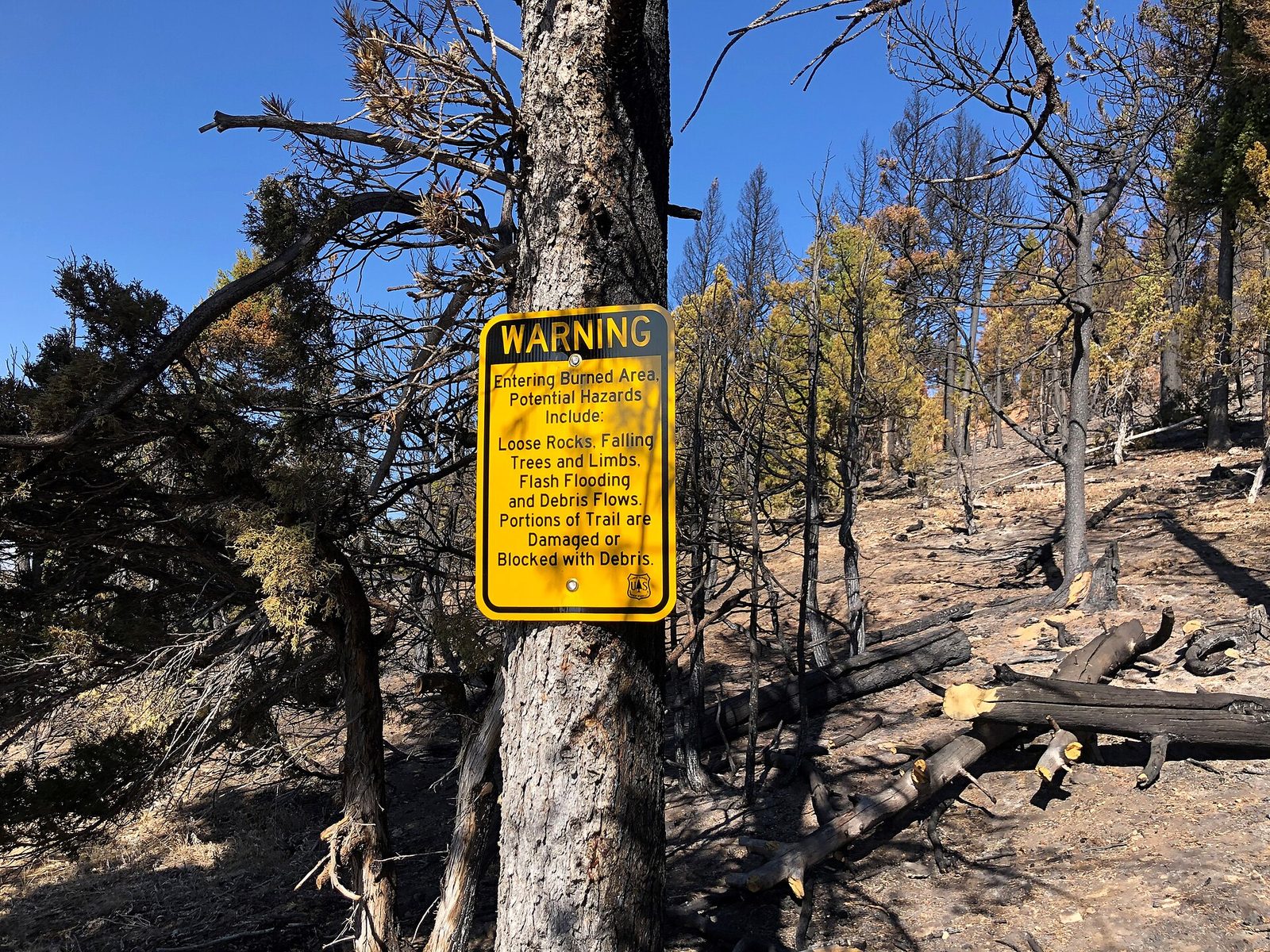
This post covers wildland fire: the physical, chemical and biological changes, how long recovery takes, and the treatments agencies actually use. Fires that burn homes leave other residues, covered in wildfire ash and metals. The site profile is at wildfire burn scars.
Burn severity decides most of it
What fire does to soil comes down mainly to burn severity, a mix of peak temperature and duration. Climate, vegetation and topography set how well the soil bounces back [1]. A review in Oecologia lays out the contrast. Low to moderate fires, like most prescribed burns, bring a short rise in pH and available nutrients and nothing irreversible. Severe wildfires strip organic matter, damage soil structure and porosity, lose nutrients, and change microbial and invertebrate communities markedly [1].
The U.S. Forest Service puts numbers on the heat [2]:
| Organisms | Lethal soil temperature |
|---|---|
| Some bacteria (thin-walled nitrifiers) | As low as 50 °C (122 °F) |
| Fungi | 50 to 155 °C (122 to 311 °F) |
| Virtually all bacteria | Above 200 °C (392 °F) |
Medium and high severity fires usually reach those temperatures 5 cm (2 inches) or more down into the mineral soil [2]. Low-severity fire barely touches soil life [2].
Physical changes
Fire consumes the litter and plants that shield soil from rain, along with the organic matter that holds soil particles together in aggregates. The Forest Service describes the sequence: structure collapses, pore space shrinks, the surface compacts and infiltration drops [2].
Intense heat vaporizes organic material in the soil, USGS explains, and as those vapors cool they condense into a waxy, water-repellent coating on soil particles [3]. The Forest Service adds that the repellent layer gets pushed deeper into the profile. Rain soaks in a short way, hits the layer, and the wet soil above it washes off easily [2]. DeBano’s review is the standard reference on fire and water repellency [4].
Less cover plus less infiltration sends rain overland, and USGS warns of more surface runoff and a higher risk of flash flooding [3]. The first storms after a fire usually do the most damage. Over time the repellency tends to break down and vegetation comes back [5].
Water quality suffers too, as ash and debris wash into streams after a fire, and runoff can carry more nutrients, sediment and heavy metals than before [3].
Chemical changes
Severe fires lose a lot of nutrients to volatilization, to ash carried off in smoke, to leaching and to erosion. Low to moderate fires can do the opposite for a while and release a short pulse of available nutrients [1]. The Forest Service reports that phosphorus survives to a higher temperature than nitrogen, so burned organic matter leaves a fair amount of highly available phosphorus in the surface ash [2].
Biological changes
Heat kills soil life selectively: fungi generally die at lower temperatures than bacteria, and the species that survive are a different mix from what was there before [2].
Fungi take the bigger loss: a meta-analysis of fire studies found fire cut fungal species richness by 28% on average and mycorrhizal colonization in the field by 21%. Bioassays run off site showed no significant drop, which suggests the soil often keeps its potential to colonize roots even where field roots have lost it [6].
Some organisms do better after a fire, and across a burn-severity gradient in the Canadian boreal forest, certain bacteria and fungi became far more abundant. The abstract reports Massilia at 64 times its unburned abundance and Arthrobacter at 35 times [7].
In the Forest Service summary, most studies show microbial populations in the mineral soil recovering to pre-fire levels within 1 to 4 years, though some report reduced microbial biomass for as long as 11 years. No ecosystem stays sterile even after severe disturbance, the same source notes, and how fully the community recolonizes depends on how long the forest floor takes to rebuild [2].
Certini’s review draws the practical conclusion that where plants recolonize promptly, most soil properties can return to their pre-fire level and sometimes improve on it [1].
A rough recovery timeline
| Period | What is typically happening | Source |
|---|---|---|
| First rains | Highest erosion and flood risk; water-repellent layer limits infiltration | [2][3][5] |
| First growing season | Plant cover and roots return where seed and roots survived; treatments such as seeding and mulch aim to speed this | [5] |
| Over following months | The longer the time since the fire, the more likely water repellency is to break down and cover to regrow | [5] |
| 1 to 4 years | Microbial populations in mineral soil commonly recover to pre-fire levels | [2] |
| Up to 11 years | Reduced microbial biomass reported in some studies | [2] |
Fire severity, slope, soil and rainfall all shift these ranges.
Treatments agencies use
After large fires, Burned Area Emergency Response (BAER) teams map soil burn severity and prescribe treatments. A 2021 chapter by a Forest Service researcher lists the most common soil conservation treatments in 2020 as aerial seeding, mulching, straw wattles and culvert removal. Straw mulch needs 60% to 70% ground cover to work, and a layer that is too thick can hold back natural regrowth. When treatments fail, the chapter says, the cause is often outside anyone’s control: fire severity, slope, rainfall [5].
We don’t cite field data on compost or microbial amendments for burned slopes here, so this post makes no claims about them. The research above supports one cautious point: burned soil regenerates slowly as long as erosion is held off and plants come back [1][2].
Who to call
Start with the land manager or county agency that ran the post-fire assessment, then the state forestry or natural resources agency. For farm or ranch soil, the local conservation district. If ash or debris from burned structures is in the soil, a lab can test it for contaminants.
Planning for your slope
Burn severity, soil type and next season’s rain set the pace on any given slope, and most of the studies above come from forests. Rangeland, chaparral and suburban soils can behave differently. We map the ground, sample it, and measure regrowth and soil biology against an untreated patch. If you have burned soil on your land, send us a note.
Sources
All links checked 2026-10-01.
- Certini G. Effects of fire on properties of forest soils: a review. Oecologia 143:1 to 10 (2005). doi:10.1007/s00442-004-1788-8
- Neary DG, Ryan KC, DeBano LF, eds. Wildland fire in ecosystems: effects of fire on soils and water. USDA Forest Service General Technical Report RMRS-GTR-42, vol. 4 (2005). research.fs.usda.gov
- U.S. Geological Survey. The Good, the Bad, the Ugly: How Wildfires Reshape Landscapes (May 5, 2025). usgs.gov
- DeBano LF. The role of fire and soil heating on water repellency in wildland environments: a review. Journal of Hydrology 231 to 232:195 to 206 (2000). doi:10.1016/S0022-1694(00)00194-3
- Neary DG, Leonard JM. Soil conservation after wildfires: challenges, failures, and successes. In: Vieira AAB, Goncalves AJB, eds. Soil Conservation: Strategies, Management and Challenges. Nova Science Publishers (2021). research.fs.usda.gov
- Dove NC, Hart SC. Fire reduces fungal species richness and in situ mycorrhizal colonization: a meta-analysis. Fire Ecology 13(2):37 to 65 (2017). doi:10.4996/fireecology.130237746
- Whitman T, Whitman E, Woolet J, Flannigan MD, Thompson DK, Parisien MA. Soil bacterial and fungal response to wildfires in the Canadian boreal forest across a burn severity gradient. Soil Biology and Biochemistry 138:107571 (2019). doi:10.1016/j.soilbio.2019.107571