
Site type
Train Derailments
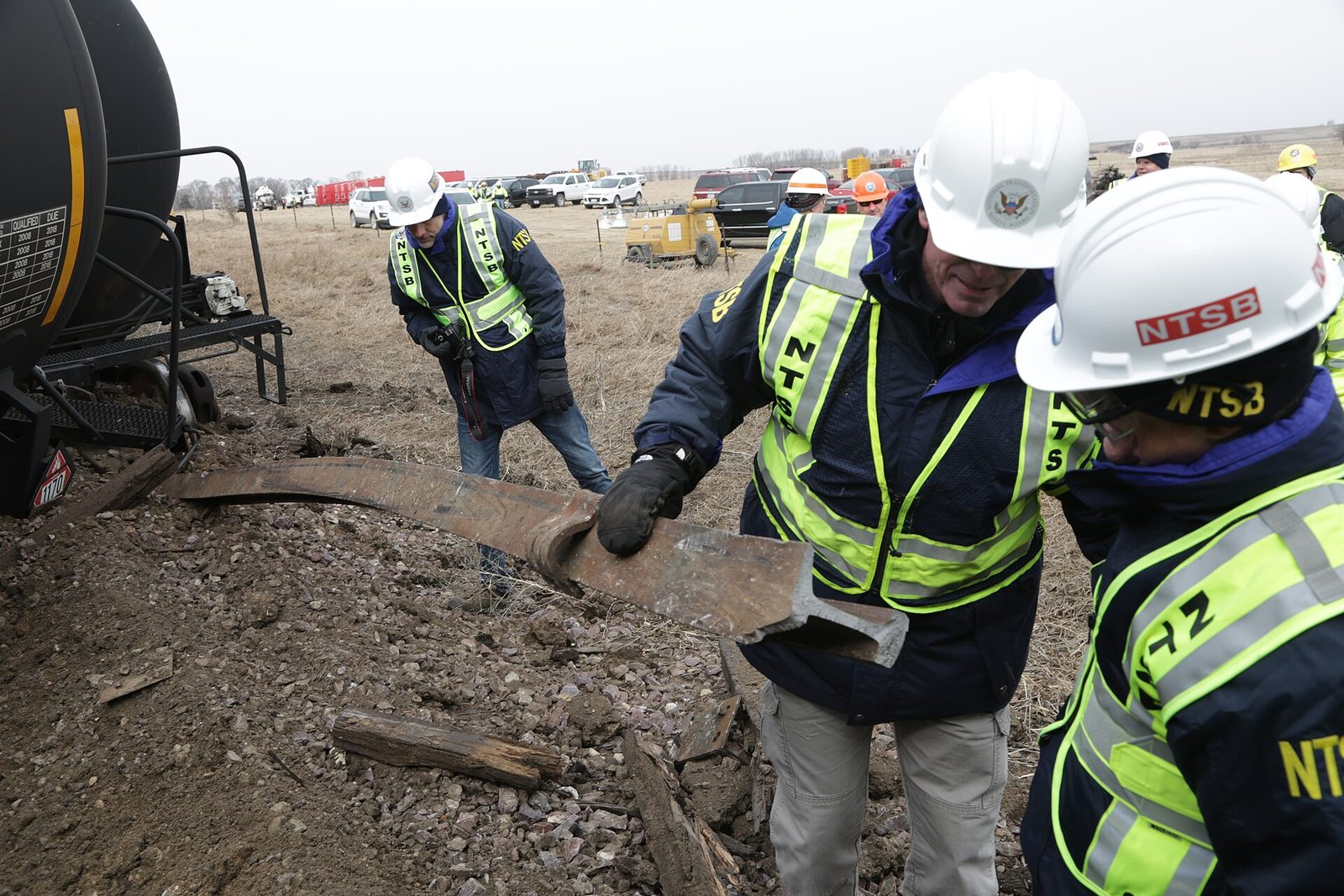
After a derailment, emergency cleanup comes first. Soil biology fits in the long tail: biodegradable spills, post-excavation ground that has to grow again, and the monitoring that tells a community what is actually happening.
.jpg)
On this page (7 sections)
Most derailments release nothing hazardous: of 1,087 U.S. derailments in 2021, federal data compiled by the Congressional Research Service count 25 as reportable hazardous materials incidents [1]. When cargo does get out, the soil along the track can carry it for years.
What is usually in the soil
That depends on the cargo and whether it burned.
- Fuels and oils, meaning locomotive diesel and refined petroleum cargo, are among the most biodegradable contaminants there are.
- Industrial chemicals include solvents, monomers such as vinyl chloride and butyl acrylate, glycol ethers and acids, each behaving differently in soil and water.
- Agricultural cargo spills of fertilizer, grain and ethanol cause nutrient, odor and oxygen-demand problems more often than toxic ones.
- Combustion residues from burned cargo can leave PAHs in surface soil, plus dioxins and furans where chlorinated materials burned, and these break down slowest of all.
How these sites are usually handled
The railroad is the responsible party, and U.S. EPA can order and oversee cleanup of hazardous substances under federal Superfund authority, working with state agencies [2]. In the emergency phase the standard remedy is excavation: contaminated soil goes by truck to licensed disposal facilities, liquids are collected and shipped off site, and the dug-out areas are backfilled with clean soil and seeded.
The 2023 derailment at East Palestine, Ohio followed that pattern: emergency excavation, then a long monitoring phase [3]. In an emergency speed wins and digging is fast, so biology belongs to the phase that follows.
Where biology fits
Many spilled chemicals are biodegradable, and EPA’s guide describes bioremediation as microbes using contaminants for food and energy, and lists petroleum, solvents and pesticides among the contaminants treated that way [4]. Researchers sampling creek sediment downstream of a 2023 derailment found native microbes that broke down vinyl chloride with oxygen present and butyl acrylate without it [5]. That is natural attenuation, the established regulatory route for low-level residual contamination: measure it, support it where it makes sense, keep measuring.
Excavated ground has to grow again, yet backfill and imported topsoil arrive with little life and poor structure. Living soil is held together by fungal networks and microbial glues that build stable aggregates [6]. Bringing that biology back to rail corridors, banks and backfilled yards is soil-health work, and it is where we are most useful.
Combustion residues need a long-term plan, because dioxins and heavier PAHs bind tightly to soil. Research shows aerobic bacteria can degrade the lower-chlorinated dioxins, while the most chlorinated forms resist microbial attack [7]. Carbon amendments such as biochar bind organic contaminants and reduce how much can reach water or living things [8]. Binding plus biology is a reasonable approach to test, over years.
After a derailment, independent data collected the same way over time is the most useful thing any team can give a community.
Biological work on a derailment site happens under a regulator-approved work plan and adds to an ordered cleanup without replacing it. Results take months to a year or more, confirmed by lab testing.
Microbes in our products with research on rail cargo
Independent DNA sequencing by Biome Makers identified 291 microbial species in Elm Dirt’s Plant Juice. Peer-reviewed research shows several can act on chemicals common on rail lines:
- Pseudomonas putida degrades diesel-range alkanes, including as part of a bacterial consortium in a 365-day field study [9], and one strain grows on vinyl chloride as its only source of carbon and energy [12]. Strains also degrade 2-butoxyethanol, a glycol ether solvent [10], and a refinery-soil isolate depleted 40 percent of a BTEX mixture in 36 hours [13].
- Desulfitobacterium dichloroeliminans strips both chlorines off 1,2-dichloroethane in one step, producing ethene instead of vinyl chloride [14]. It has been injected into contaminated groundwater at an industrial site and tracked as the contaminant came down [15].
- Comamonas testosteroni transforms trichloroethylene and all three dichloroethene isomers while feeding on phenol. Paired with a vinyl chloride degrader, it brought a five-compound chloroethene mixture down to near zero [16]. In PAH-contaminated soil it cleared 81 percent of the phenanthrene in 25 days [17].
- Variovorax paradoxus degrades all six BTEX compounds and keeps going at a fraction of normal dissolved oxygen [18], which is how most spill sites actually are.
- Pseudomonas stutzeri: one strain held carbon tetrachloride removal at 98 to 99.9 percent for four years in a full-scale groundwater biocurtain in Michigan [11].
Whether they do it along your line gets tested there, with an independent lab. The full list is in the microbe library.
What to ask before you start
- Who holds the work plan, and which agency has to approve in-situ work?
- What was released, and does the fire residue cover a different footprint from the spill?
- Where has excavation already happened, and how will those areas grow again?
- Who collects the data, and will the community see it first?
Talk with us
Local officials, consultants and landowners dealing with ground along a rail line can reach us here. We help plan soil restoration and a monitoring design that holds up.
Sources
- Congressional Research Service. East Palestine, OH, Train Derailment and Hazardous Materials Shipment by Rail: Frequently Asked Questions (R47435). congress.gov
- Congressional Research Service. Comprehensive Environmental Response, Compensation, and Liability Act: A Summary of Superfund Cleanup Authorities and Related Provisions of the Act (R41039). congress.gov
- U.S. EPA. East Palestine Operational Updates. epa.gov
- U.S. EPA (2012). A Citizen’s Guide to Bioremediation (EPA 542-F-12-003). semspub.epa.gov
- Chen G, Rosolina S, Padilla-Crespo E, et al. (2024). Natural attenuation potential of vinyl chloride and butyl acrylate released in the East Palestine, Ohio train derailment accident. Environmental Science & Technology 58(40):17743–17755. doi:10.1021/acs.est.4c04198
- Rillig MC, Mummey DL (2006). Mycorrhizas and soil structure. New Phytologist 171(1):41–53. doi:10.1111/j.1469-8137.2006.01750.x
- Field JA, Sierra-Alvarez R (2008). Microbial degradation of chlorinated dioxins. Chemosphere 71(6):1005–1018. doi:10.1016/j.chemosphere.2007.10.039
- Ghosh U, Luthy RG, Cornelissen G, et al. (2011). In-situ sorbent amendments: a new direction in contaminated sediment management. Environmental Science & Technology 45(4):1163–1168. doi:10.1021/es102694h
- Szulc A, Ambrożewicz D, Sydow M, et al. (2014). The influence of bioaugmentation and biosurfactant addition on bioremediation efficiency of diesel-oil contaminated soil: feasibility during field studies. Journal of Environmental Management 132:121–128. doi:10.1016/j.jenvman.2013.11.006
- Woiski C, Dobslaw D, Engesser KH (2020). Isolation and characterization of 2-butoxyethanol degrading bacterial strains. Biodegradation 31(3):153–169. doi:10.1007/s10532-020-09900-3
- Dybas MJ, Hyndman DW, Heine R, et al. (2002). Development, operation, and long-term performance of a full-scale biocurtain utilizing bioaugmentation. Environmental Science & Technology 36(16):3635–3644. doi:10.1021/es0114557
- Danko AS, Luo M, Bagwell CE, Brigmon RL, Freedman DL (2004). Involvement of linear plasmids in aerobic biodegradation of vinyl chloride. Applied and Environmental Microbiology 70(10):6092–6097. doi:10.1128/AEM.70.10.6092-6097.2004
- Chicca I, et al. (2020). Degradation of BTEX mixture by a new Pseudomonas putida strain: role of the quorum sensing in the modulation of the upper BTEX oxidative pathway. Environmental Science and Pollution Research 27(29):36203–36214. doi:10.1007/s11356-020-09650-y
- De Wildeman S, Linthout G, Van Langenhove H, Verstraete W (2004). Complete lab-scale detoxification of groundwater containing 1,2-dichloroethane. Applied Microbiology and Biotechnology 63(5):609–612. doi:10.1007/s00253-003-1363-y
- Maes A, Van Raemdonck H, Smith K, Ossieur W, et al. (2006). Transport and activity of Desulfitobacterium dichloroeliminans strain DCA1 during bioaugmentation of 1,2-DCA-contaminated groundwater. Environmental Science & Technology 40(17):5544–5552. doi:10.1021/es060953i
- Zalesak M, Ruzicka J, Vicha R, Dvorackova M (2021). Examining aerobic degradation of chloroethenes mixture in consortium composed of Comamonas testosteroni RF2 and Mycobacterium aurum L1. Chemosphere 269:128770. doi:10.1016/j.chemosphere.2020.128770
- Lu Q, et al. (2022). Effects of Comamonas testosteroni on dissipation of polycyclic aromatic hydrocarbons and the response of endogenous bacteria for soil bioremediation. Environmental Science and Pollution Research 29(54):82351–82364. doi:10.1007/s11356-022-21497-z
- Benedek T, et al. (2021). Potential of Variovorax paradoxus isolate BFB1_13 for bioremediation of BTEX contaminated sites. AMB Express 11(1):126. doi:10.1186/s13568-021-01289-3
Managing a site like this?
Tell us where it is and what's been tested, and we'll tell you where biology fits in the plan, if it fits at all.