
Site type
Wildfire Burn Scars
Fire leaves two problems in the ground: ash residues where buildings burned, and soil that sheds water and has lost its biology. Debris removal handles the first, and rebuilding living soil is the long second half.
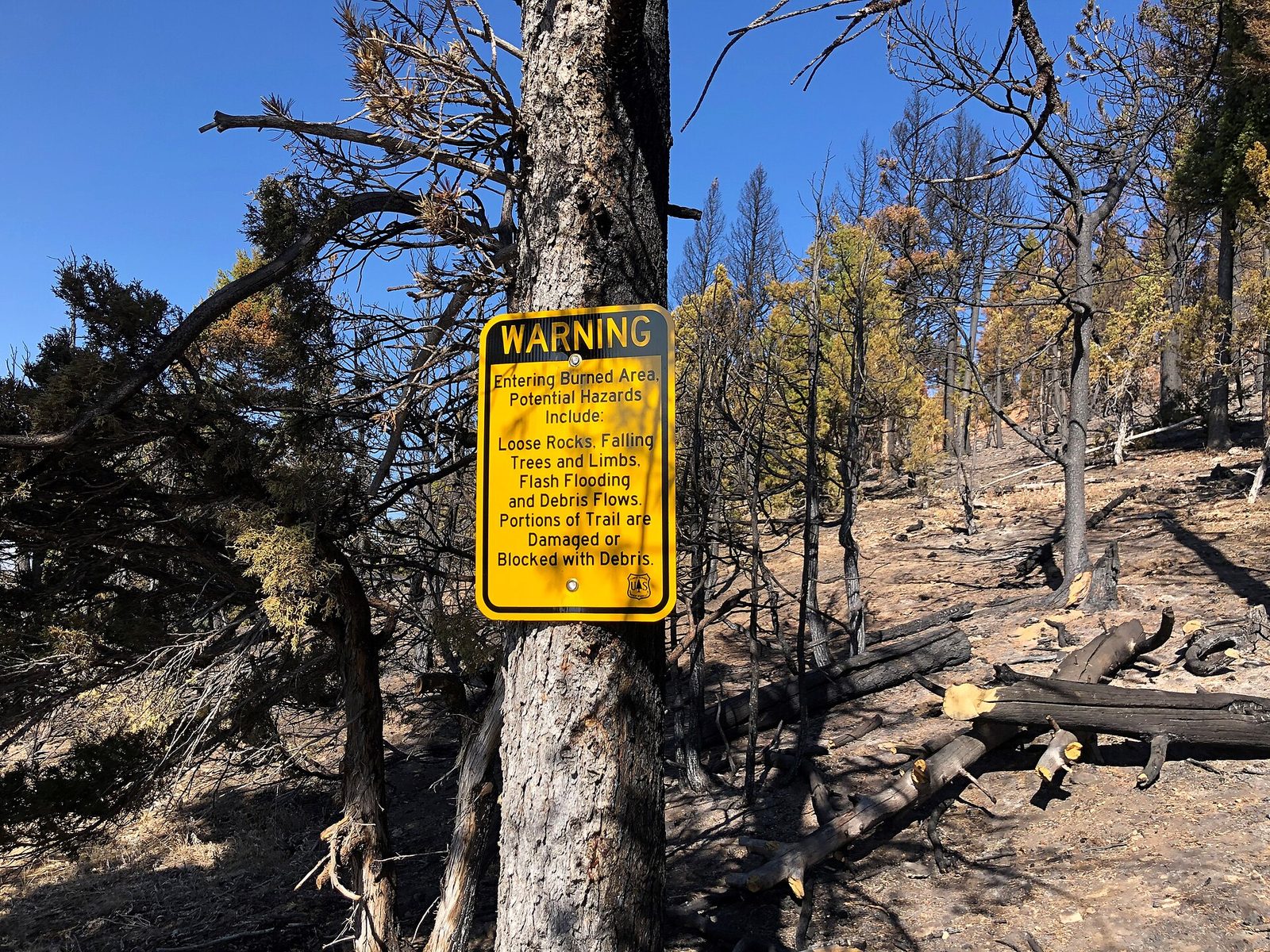
_work_(53818065371).jpg)
On this page (7 sections)
Lahaina, on Maui, burned in August 2023. The Palisades and Eaton fires burned through Los Angeles County in January 2025. In both places, families and agencies wanted to know whether the ground was safe and how it would come back.
What is usually in the soil
When homes, cars and their contents burn, metals concentrate in the ash. After the Lahaina fire, the Hawaii Department of Health tested ash from 100 properties and reported elevated arsenic, lead, antimony, cobalt and copper. Arsenic averaged 280 mg/kg against an acceptable level of 23, and lead averaged 410 mg/kg against 200 [1].
Fires can also leave PAHs, and sometimes dioxins and furans, in surface soil. Los Angeles County’s sampling after the 2025 fires tested for metals, PAHs, and dioxins and furans [2].
Soil can be damaged even where nothing toxic is left. Heat drives waxy compounds from burning plant litter down into the soil, where they condense into a water-repellent layer just under the surface [3]. Rain that used to soak in runs off and takes soil with it. Where topsoil burns hot or gets scraped away, most of its biology goes too. The repellent layer is temporary, lasting anywhere from under a year to several years depending on the fire and soil [3].
How these sites are usually handled
In burned neighborhoods, the federal response removes debris and the top layer of soil. After the January 2025 fires, the U.S. Army Corps of Engineers removed debris and the top six inches of soil under burned structures. EPA then took 4,200 soil borings across 100 randomly selected properties in the Eaton Fire area and reported 98 of 100 below the federal lead screening level in subsurface soil, and 95 of 100 at the surface [4]. In the Palisades Fire area, Los Angeles County found no widespread contamination and two isolated areas above screening levels [2].
That settles whether a lot is safe to rebuild on. A lot scraped six inches down has still lost its topsoil, its organic matter and most of its biology.
Where biology fits
Compost, mulch, native seed and organic amendments are standard tools for restoring land after fire. Fungal networks and microbial byproducts bind soil particles into aggregates that hold water and resist erosion [5], so putting living biology back into stripped or burned soil helps directly on hillsides, lots, parks and watersheds, which makes recovery the strongest fit for our work.
For combustion organics, peer-reviewed research shows several bacteria in our products can break down PAHs in soil (below). That supports PAH reduction over time, checked by testing, alongside debris removal.
Microbes don’t destroy lead or arsenic, although some fungi and bacteria bind metals, change their chemical form or help plants absorb them, which changes how easily they move. In one field study, the fungus Trichoderma harzianum with biochar raised metal uptake by mustard plants and lowered total soil cadmium and arsenic [6]. T. harzianum has been identified in Elm Dirt’s Bloom Juice. Metal-laden ash still goes out with the debris removal and testing program.
Soil biology comes back over seasons, so plan on months to a year or more and test along the way.
Microbes in our products with research here
Independent lab analysis (Biome Makers) identified these species in Elm Dirt’s Plant Juice (291 species in all), and peer-reviewed research shows what each can do:
- Comamonas testosteroni degrades PAHs in soil, and in one soil study it removed 81 percent of the phenanthrene and 38 percent of the benzo[a]pyrene in 25 days and made the soil’s own PAH degraders more active [7]. The heaviest PAHs respond best to bacteria and fungi together, so on a burn scar a product carrying both groups has an advantage [8].
- Cupriavidus metallidurans carries gene systems for cadmium, zinc, copper, lead and other metals and has been used in engineered systems to precipitate metals [9].
What they do on your ground gets tested there, with an independent lab. More in the microbe library.
Funding and agencies
FEMA funded the post-fire soil sampling in the Eaton Fire area, and EPA carried it out [4]. Debris removal runs through the U.S. Army Corps of Engineers. State and county health departments set local soil guidance, as the Hawaii Department of Health and Los Angeles County Public Health did [1][2]. Once debris is gone, restoring slopes and watersheds is where a county or landowner gets the most from a soil-biology partner.
Talk with us
If you manage burned land, a rebuild program or a watershed, we can help plan soil recovery and a sampling schedule that shows whether it is working. Get in touch.
Sources
- Hawaii Department of Health. “Lahaina Ash Characterization Testing Show Elevated Levels of Toxic Substances.” News release, December 10, 2023. health.hawaii.gov
- Los Angeles County Department of Public Health. “Public Health Releases Final Findings of Soil Testing in Fire Areas.” publichealth.lacounty.gov
- U.S. Geological Survey. Fire-Induced Water-Repellent Soils: An Annotated Bibliography (Open-File Report 97-720). pubs.usgs.gov
- U.S. EPA. “EPA’s Eaton Fire Soil Sampling Confirms Federal Cleanup Protocols Effectively Remediated Burn Debris Contamination.” News release. epa.gov
- Rillig MC, Mummey DL (2006). Mycorrhizas and soil structure. New Phytologist 171(1):41–53. doi:10.1111/j.1469-8137.2006.01750.x
- Yao S, Zhou B, Duan M, et al. (2023). Combination of biochar and Trichoderma harzianum can improve the phytoremediation efficiency of Brassica juncea and the rhizosphere micro-ecology in cadmium and arsenic contaminated soil. Plants 12(16):2939. doi:10.3390/plants12162939
- Lu Q, Sun X, Jiang Z, et al. (2022). Effects of Comamonas testosteroni on dissipation of polycyclic aromatic hydrocarbons and the response of endogenous bacteria for soil bioremediation. Environmental Science and Pollution Research 29:82351–82364. doi:10.1007/s11356-022-21497-z
- Boonchan S, Britz ML, Stanley GA (2000). Degradation and mineralization of high-molecular-weight polycyclic aromatic hydrocarbons by defined fungal-bacterial cocultures. Applied and Environmental Microbiology 66(3):1007–1019. doi:10.1128/AEM.66.3.1007-1019.2000
- Diels L, Van Roy S, Taghavi S, Van Houdt R (2009). From industrial sites to environmental applications with Cupriavidus metallidurans. Antonie van Leeuwenhoek 96(2):247–258. doi:10.1007/s10482-009-9361-4
Managing a site like this?
Tell us where it is and what's been tested, and we'll tell you where biology fits in the plan, if it fits at all.