
Bacterium · Soil-tested aromatic specialist
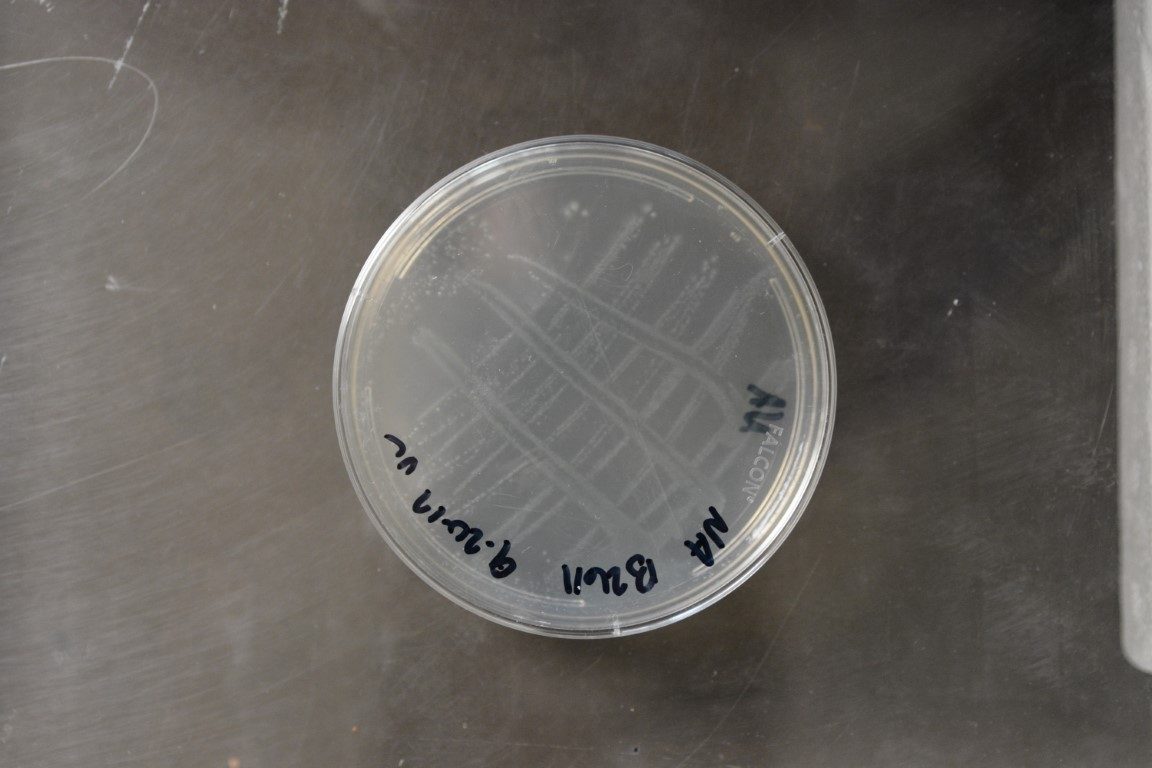
Comamonas testosteroni
Inoculated into PAH-contaminated soil it cleared most of the phenanthrene and naphthalene in 25 days, and it made the soil's own degraders more active. It also works on phthalates and on chlorinated solvents.

| Contaminant | What the research documents |
|---|---|
| PAHs & SVOCs | Ring-cleaving dioxygenases; 81% phenanthrene, 63% naphthalene, 38% benzo[a]pyrene removed in soil at day 25; Phthalate dioxygenase; complete removal of phthalic and terephthalic acid at 100 mg/L |
| Dioxins & furans | Strains of the genus grow on dibenzofuran as sole carbon source using angular dioxygenation at the 4,4a position |
| Heavy metals | Selenite reduction to elemental selenium; antimony transformation (strain S44) |
| Chlorinated solvents & VOCs | Cometabolic transformation of trichloroethylene and all three dichloroethene isomers while growing on phenol (strain RF2) |
From published research on the species, not tests of an Elm Dirt product. Studies often work with one strain, and sequencing identifies species, so results on a site are measured on that site.
On this page (5 sections)
What it is
Comamonas testosteroni is a soil and freshwater bacterium that specializes in aromatic compounds, the flat ring-shaped molecules in tar, creosote and soot.
Peer-reviewed research shows Comamonas testosteroni can degrade polycyclic aromatic hydrocarbons in soil. It is one of the 291 microbial species identified in Plant Juice by independent lab analysis (Biome Makers), and it also appears in the Biome Makers lab profile of Bloom Juice.
What the research shows
Inoculated into PAH-contaminated soil, C. testosteroni removed 81 percent of the phenanthrene, 63 percent of the naphthalene and 38 percent of the benzo[a]pyrene by day 25 [1]. The light two- and three-ring PAHs went fast, while benzo[a]pyrene, the five-ring carcinogen regulators watch most closely, came down slowly.
The inoculated bacterium also made the soil’s native PAH degraders more active, so adding it supported the existing population.
Strain S44, isolated from metal-contaminated soil, reduces selenite to elemental selenium [2] and transforms antimony [3].
Among chlorinated solvents, strain RF2 transforms trichloroethylene and all three dichloroethene isomers while feeding on phenol. Paired with a vinyl chloride degrader, it brought a five-compound chloroethene mixture down to near zero, vinyl chloride included [5].
The species is a reference organism for phthalate breakdown, and its phthalate dioxygenase has been solved structurally and kinetically [6], and five strains completely removed 100 mg/L of both phthalic and terephthalic acid [7]. Phthalates appear on the same semivolatile lab panel as PAHs.
Three Comamonas strains from white clover roots grow on dibenzofuran as their only carbon source, and strain KD7 opens the ring by angular dioxygenation at the 4,4a position, the same attack the dedicated dioxin organisms use [8]. The strains also colonized clover roots and promoted plant growth. The biphenyl dioxygenase of strain B-356, published under this species name and since reclassified as Pandoraea pnomenusa, oxygenates dibenzofuran and dibenzo-p-dioxin as well [4].
How it works
Ring-cleaving dioxygenases insert oxygen into an aromatic ring and split it open. The fragments go into ordinary metabolism and end up as carbon dioxide and biomass, so the contaminant is broken down where it sits.
Where it fits
Its PAH results come from soil, with the native degraders working harder alongside it. It suits burn sites, rail corridors, roadsides and any topsoil holding tar, soot or creosote residue; see PAHs and SVOCs. Whether it performs on a given site gets measured there, over months to a year or more, by an independent lab.
Studies
- Lu Q, et al. (2022). Effects of Comamonas testosteroni on dissipation of polycyclic aromatic hydrocarbons and the response of endogenous bacteria for soil bioremediation. Environmental Science and Pollution Research 29(54):82351–82364. doi:10.1007/s11356-022-21497-z
- Zheng S, et al. (2014). Selenite reduction by the obligate aerobic bacterium Comamonas testosteroni S44 isolated from a metal-contaminated soil. BMC Microbiology 14:204. doi:10.1186/s12866-014-0204-8
- Luo X, et al. (2023). Toxic response of antimony in the Comamonas testosteroni and its application in soil antimony bioremediation. Environment International 177:108040. doi:10.1016/j.envint.2023.108040
- L’Abbée JB, Barriault D, Sylvestre M (2005). Metabolism of dibenzofuran and dibenzo-p-dioxin by the biphenyl dioxygenase of Burkholderia xenovorans LB400 and Comamonas testosteroni B-356. Applied Microbiology and Biotechnology 67(4):506–514. doi:10.1007/s00253-004-1791-3
- Zalesak M, Ruzicka J, Vicha R, Dvorackova M (2021). Examining aerobic degradation of chloroethenes mixture in consortium composed of Comamonas testosteroni RF2 and Mycobacterium aurum L1. Chemosphere 269:128770. doi:10.1016/j.chemosphere.2020.128770
- Mahto JK, et al. (2021). Molecular insights into substrate recognition and catalysis by phthalate dioxygenase from Comamonas testosteroni. Journal of Biological Chemistry 297(6):101416. doi:10.1016/j.jbc.2021.101416
- Vural C, Ettadili H (2024). Biodegradation of phthalic acid and terephthalic acid by Comamonas testosteroni strains. Folia Microbiologica 69(6):1343–1353. doi:10.1007/s12223-024-01176-x
- Wang Y, Yamazoe A, Suzuki S, Liu CT, et al. (2004). Isolation and characterization of dibenzofuran-degrading Comamonas sp. strains isolated from white clover roots. Current Microbiology 49(4):288–294. doi:10.1007/s00284-004-4348-x
Want to know what's documented for your contaminants?
Tell us what's in the soil, and we'll point you to the organisms and studies that apply, and say where the research is thin.