
Bacterium · Full-scale record on carbon tetrachloride
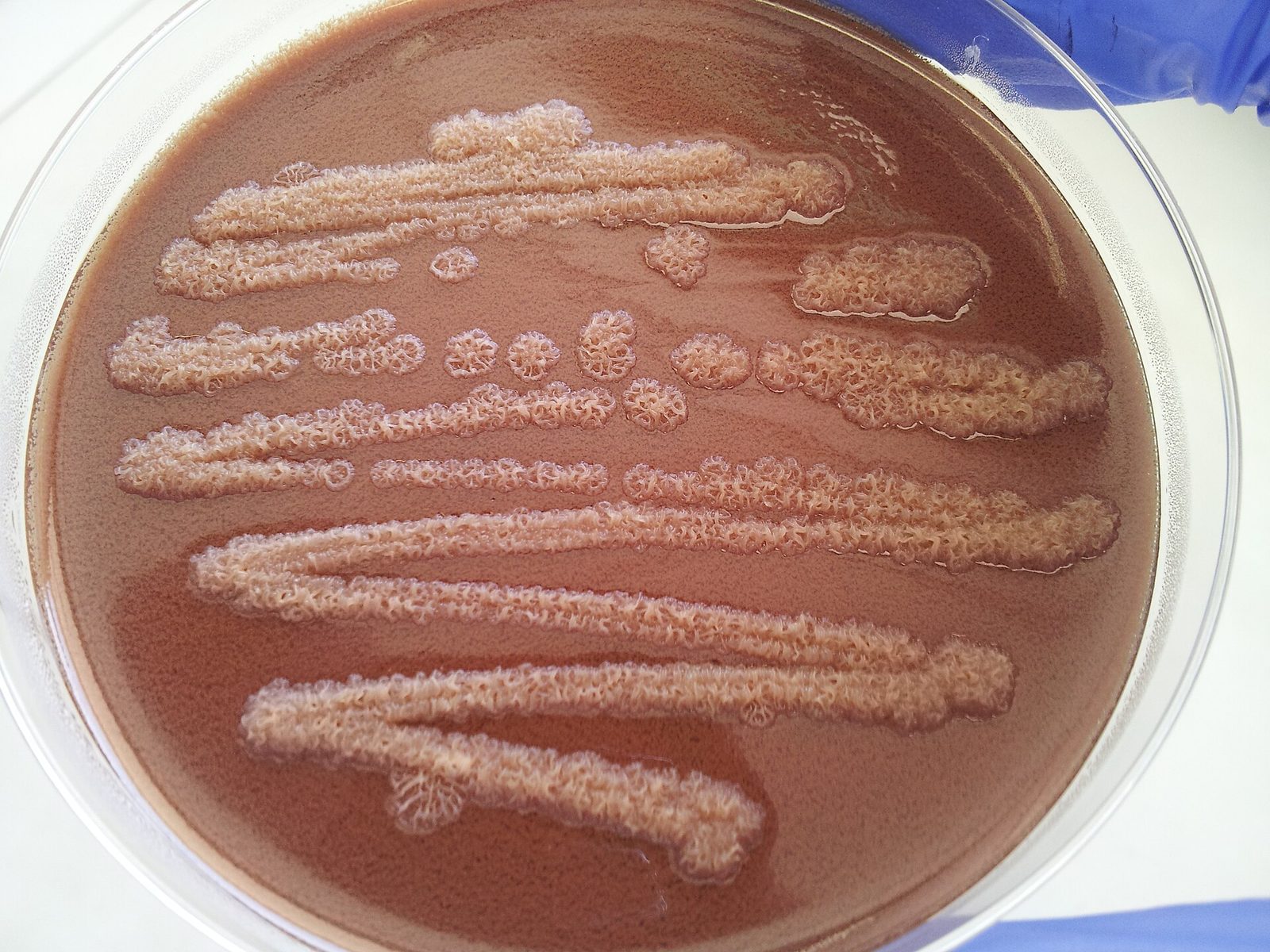
Pseudomonas stutzeri
The organism behind the clearest full-scale bioremediation result in this library: a living barrier in a Michigan aquifer that held carbon tetrachloride removal for four years.

| Contaminant | What the research documents |
|---|---|
| PAHs & SVOCs | Upper naphthalene pathway (strain AN10) |
| Heavy metals | pdtc reduces chromium(VI) and precipitates mercury, cadmium, lead and arsenic |
| Chlorinated solvents & VOCs | Cometabolic transformation of carbon tetrachloride by the pdtc siderophore (strain KC), without producing chloroform |
From published research on the species, not tests of an Elm Dirt product. Studies often work with one strain, and sequencing identifies species, so results on a site are measured on that site.
On this page (5 sections)
What it is
Pseudomonas stutzeri is a widespread soil and water bacterium. Environmental engineers know it for one strain, KC, isolated from an aquifer in Michigan.
Peer-reviewed research shows Pseudomonas stutzeri can transform carbon tetrachloride and degrade naphthalene. It is one of the 291 microbial species identified in Plant Juice by independent lab analysis (Biome Makers), and it also appears in the Biome Makers lab profile of Bloom Juice.
What the research shows
At Schoolcraft, Michigan, strain KC was injected into a contaminated aquifer to form a living “biocurtain” across the plume. It removed 98 to 99.9 percent of the carbon tetrachloride and held that for four years, treating roughly 18,600 cubic meters of groundwater [1]. Most bioremediation evidence stops at the lab bench, and this ran in the ground, at scale, under monitoring.
The strain also transforms carbon tetrachloride without making chloroform, the usual toxic byproduct of the anaerobic routes [2].
Strain AN10 carries a chromosomally encoded pathway for the first steps of naphthalene breakdown [4].
The molecule behind the carbon tetrachloride chemistry, a small iron-grabbing compound called pdtc, also reduces chromium(VI) and precipitates mercury, cadmium, lead and arsenic in lab tests [5], although the metals only change form and the change can reverse.
How it works
Strain KC releases pyridine-2,6-bis(thiocarboxylic acid), or pdtc. Paired with copper, pdtc attacks carbon tetrachloride outside the cell. The bacterium gains nothing from the reaction, so it counts as cometabolism.
Where it fits
It is the clearest published case of a soil bacterium sustaining a cleanup at full scale. The Schoolcraft project also took a characterized site, engineered delivery and years of monitoring [3], which is what solvent work requires; see chlorinated solvents and VOCs.
Studies
- Dybas MJ, et al. (2002). Development, operation, and long-term performance of a full-scale biocurtain utilizing bioaugmentation. Environmental Science & Technology 36(16):3635–3644. doi:10.1021/es0114557
- Dybas MJ, Tatara GM, Criddle CS (1995). Localization and characterization of the carbon tetrachloride transformation activity of Pseudomonas sp. strain KC. Applied and Environmental Microbiology 61(2):758–762. doi:10.1128/aem.61.2.758-762.1995
- Sewell HL, et al. (2024). Pseudomonas stutzeri KC carries the pdt genes for carbon tetrachloride degradation on an integrative and conjugative element. Microbial Physiology 34(1). doi:10.1159/000538783
- Bosch R, García-Valdés E, Moore ER (1999). Genetic characterization and evolutionary implications of a chromosomally encoded naphthalene-degradation upper pathway from Pseudomonas stutzeri AN10. Gene 236(1):149–157. doi:10.1016/s0378-1119(99)00241-3
- Zawadzka AM, Crawford RL, Paszczynski AJ (2007). Pyridine-2,6-bis(thiocarboxylic acid) produced by Pseudomonas stutzeri KC reduces chromium(VI) and precipitates mercury, cadmium, lead and arsenic. BioMetals 20(2):145–158. doi:10.1007/s10534-006-9022-2
Want to know what's documented for your contaminants?
Tell us what's in the soil, and we'll point you to the organisms and studies that apply, and say where the research is thin.