
Bacterium · Cometabolic solvent oxidizer
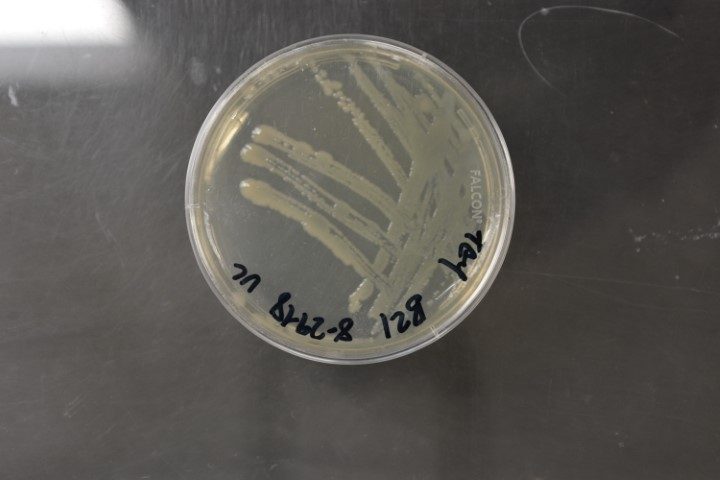
Pseudomonas mendocina
Carries toluene-4-monooxygenase, an enzyme broad enough to attack trichloroethylene and chloroform as a side reaction while the cell feeds on toluene.

| Contaminant | What the research documents |
|---|---|
| Petroleum hydrocarbons | Growth on toluene as a carbon source |
| Chlorinated solvents & VOCs | Toluene-4-monooxygenase cometabolism of trichloroethylene and chloroform (strain KR1) |
From published research on the species, not tests of an Elm Dirt product. Studies often work with one strain, and sequencing identifies species, so results on a site are measured on that site.
On this page (5 sections)
What it is
Pseudomonas mendocina is a soil and water bacterium that grows on toluene, one of the BTEX compounds in gasoline.
Peer-reviewed research shows Pseudomonas mendocina can transform trichloroethylene and chloroform by cometabolism. It is one of the 291 microbial species identified in Plant Juice by independent lab analysis (Biome Makers).
What the research shows
Strain KR1 breaks down toluene by a route first described in this organism, using toluene-4-monooxygenase, a five-gene enzyme system that hydroxylates toluene to p-cresol. The enzyme accepts a wide range of substrates and completely degrades trichloroethylene [1].
Among seven toluene-oxidizing bacteria compared, strain KR1 mineralized chloroform at 0.48 nanomoles per minute per milligram of cell protein, while Pseudomonas putida F1 degraded none [2]. Close relatives carry different enzymes, which is why this library goes organism by organism instead of by genus. A review of aerobic chloroethene breakdown lays out where each enzyme family fits [3].
How it works
The bacterium eats toluene, and because its toluene enzyme isn’t picky, it attacks nearby trichloroethylene too. The cell gains nothing from that side reaction, and the byproducts can damage the enzyme.
In practice, nothing happens when there is no feeding substrate in the ground. The activity doesn’t sustain itself the way feeding on a fuel spill does, since the organism gets no benefit, and the reaction can poison its own catalyst. Chlorinated-solvent bioremediation is engineered work for these reasons, with a deliberately supplied carbon source and monitoring.
Where it fits
Given toluene-type compounds to feed on, it attacks chlorinated solvents on the side; see chlorinated solvents and VOCs. On a site that means an engineered design and months to a year or more of independent lab monitoring.
Studies
- Yen KM, et al. (1991). Cloning and characterization of a Pseudomonas mendocina KR1 gene cluster encoding toluene-4-monooxygenase. Journal of Bacteriology 173(17):5315–5327. doi:10.1128/jb.173.17.5315-5327.1991
- McClay K, Fox BG, Steffan RJ (1996). Chloroform mineralization by toluene-oxidizing bacteria. Applied and Environmental Microbiology 62(8):2716–2722. doi:10.1128/aem.62.8.2716-2722.1996
- Mattes TE, Alexander AK, Coleman NV (2010). Aerobic biodegradation of the chloroethenes: pathways, enzymes, ecology, and evolution. FEMS Microbiology Reviews 34(4):445–475. doi:10.1111/j.1574-6976.2010.00210.x
Want to know what's documented for your contaminants?
Tell us what's in the soil, and we'll point you to the organisms and studies that apply, and say where the research is thin.