
Fungus · Multi-metal biosorbent
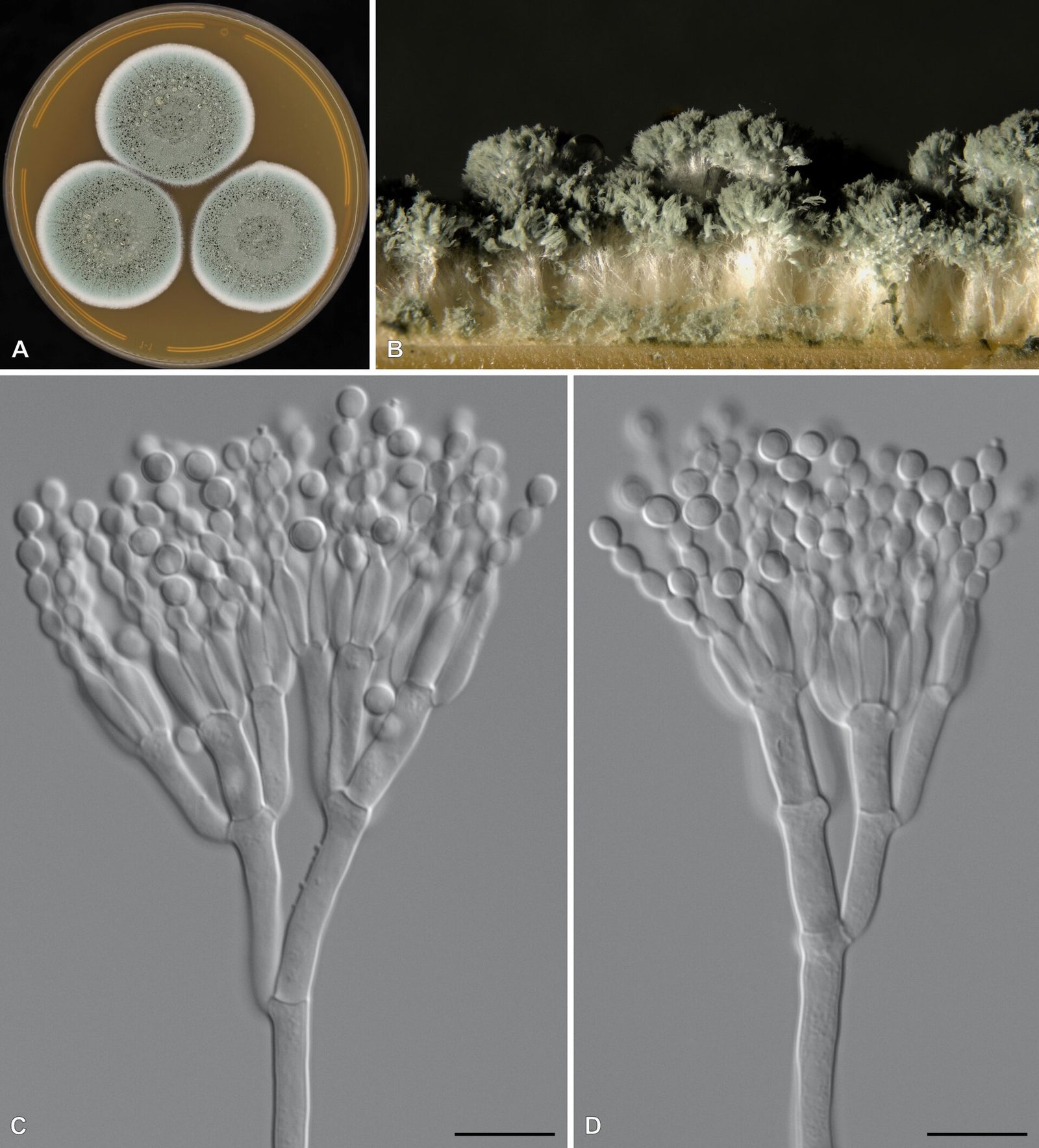
Penicillium simplicissimum
Its living cells removed 88.6 percent of chromium and 73.7 percent of lead from solution in a mechanism study that imaged where the metal ended up.

| Contaminant | What the research documents |
|---|---|
| Heavy metals | Cell-wall biosorption and bioaccumulation; live cells removed Cr 88.6%, Pb 73.7%, Cu 63.8%; uranium biomineralization |
From published research on the species, not tests of an Elm Dirt product. Studies often work with one strain, and sequencing identifies species, so results on a site are measured on that site.
On this page (5 sections)
What it is
Penicillium simplicissimum is a soil fungus that tolerates metal levels lethal to most organisms, so it is usually isolated from metal-contaminated sites and mine tailings.
Peer-reviewed research shows Penicillium simplicissimum can bind and accumulate chromium, lead, copper, cadmium and zinc. It is one of the 291 microbial species identified in Plant Juice by independent lab analysis (Biome Makers).
What the research shows
Live cells removed 88.6 percent of chromium, 73.7 percent of lead, 63.8 percent of copper, 33.1 percent of cadmium and 28.3 percent of zinc from solution. Electron microscopy and spectroscopy showed where each metal ended up, on the cell surface or inside [1].
Separate work on cadmium, zinc and lead uptake found ion exchange to be the dominant process [2].
A strain isolated from a uranium mine converts dissolved uranium into a solid mineral, with results depending on temperature and whether the cells are alive [3].
How it works
Fungal cell walls are covered in negatively charged carboxyl and phosphoryl groups, and positively charged metal ions stick to them. That biosorption works with dead biomass too. Living cells add a second route by moving metal inside and storing it.
These percentages come from solution experiments, and in soil, clay and organic matter already hold much of the metal and compete with the fungus, so flask removal figures don’t carry over to a field.
Where it fits
The genus also appears in the best benzo[a]pyrene result in the literature, a bacterial-fungal coculture that mineralized 53 percent of added benzo[a]pyrene in soil over 100 days [4]. That study used a sister species, P. janthinellum, and it is one reason our products carry bacteria and fungi together. For metals, binding holds them in place, so a metal program includes long-term monitoring by an independent lab; see heavy metals.
Studies
- Chen SH, Cheow YL, Ng SL, Ting ASY (2019). Mechanisms for metal removal established via electron microscopy and spectroscopy: a case study on metal tolerant fungi Penicillium simplicissimum. Journal of Hazardous Materials 362:394–402. doi:10.1016/j.jhazmat.2018.08.077
- Fan T, et al. (2008). Biosorption of cadmium(II), zinc(II) and lead(II) by Penicillium simplicissimum: isotherms, kinetics and thermodynamics. Journal of Hazardous Materials 160(2-3):655–661. doi:10.1016/j.jhazmat.2008.03.038
- Schaefer S, et al. (2021). Effect of temperature and cell viability on uranium biomineralization by the uranium mine isolate Penicillium simplicissimum. Frontiers in Microbiology 12:802926. doi:10.3389/fmicb.2021.802926
- Boonchan S, Britz ML, Stanley GA (2000). Degradation and mineralization of high-molecular-weight polycyclic aromatic hydrocarbons by defined fungal-bacterial cocultures. Applied and Environmental Microbiology 66(3):1007–1019. doi:10.1128/AEM.66.3.1007-1019.2000
Want to know what's documented for your contaminants?
Tell us what's in the soil, and we'll point you to the organisms and studies that apply, and say where the research is thin.