
Fungus · Lead binder, oil degrader
Mucor circinelloides
Paired with a hyperaccumulating plant in lead-contaminated soil, the combination removed 58.6 percent of the lead, more than either partner alone. An isolate of the same species has been worked on crude oil.

| Contaminant | What the research documents |
|---|---|
| Petroleum hydrocarbons | Crude-oil bioremediation by an isolated strain of the species |
| Heavy metals | Biosorption plus enhanced phytoextraction; 58.6% lead removal with Solanum nigrum vs 47.2% fungus alone and 40.2% plant alone |
From published research on the species, not tests of an Elm Dirt product. Studies often work with one strain, and sequencing identifies species, so results on a site are measured on that site.
On this page (5 sections)
What it is
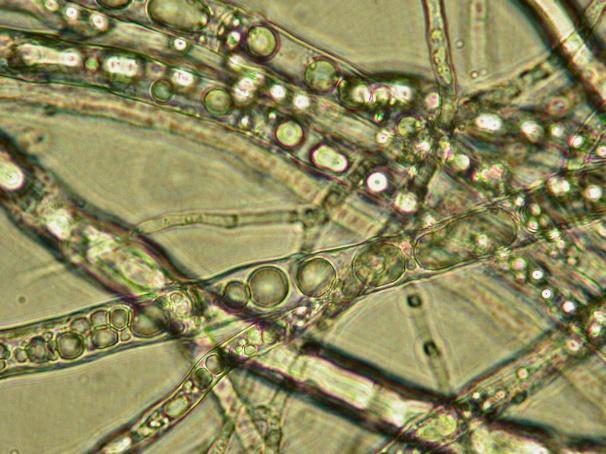
Mucor circinelloides is a fast-growing soil fungus, often isolated from mine tailings and other metal-loaded ground.
Peer-reviewed research shows Mucor circinelloides can bind lead and improve plant removal of lead from contaminated soil. It is one of the 291 microbial species identified in Plant Juice by independent lab analysis (Biome Makers), and it also appears in the Biome Makers lab profile of Bloom Juice.
What the research shows
In lead-contaminated soil planted with Solanum nigrum, a known lead accumulator, adding M. circinelloides raised total lead removal to 58.6 percent, against 47.2 percent for the fungus alone and 40.2 percent for the plant alone [1]. The pair outperformed both partners, a practical case for treating soil as a system.
Soil enzyme activity also rose after treatment, so the ground came out biologically healthier as well as lower in lead.
Follow-up work extended the fungus-plus-plant approach to lead, cadmium and arsenic [2], and a separate study characterized the fungus’s general response to metals [3].
On crude oil, a locally isolated strain was tested for crude-oil bioremediation alongside Cunninghamella echinulata [4]. On oily ground, fungal hyphae push through soil that bacteria can’t move through.
How it works
The fungal cell wall binds lead directly through the charged carboxyl and phosphoryl groups that coat it, and at the same time the fungus improves conditions for the plant, which then pulls more metal into its tissue. Binding alone holds lead in place without removing any, and a plant alone removes lead but struggles on contaminated ground, so the pairing works because the fungus keeps the plant healthy enough to keep extracting.
As with all phytoextraction, the lead ends up in plant biomass, which has to be harvested and managed or the metal returns to the soil as the plant breaks down. A proposal built on this route needs a disposal plan.
Where it fits
It fits urban lead soils and old industrial yards where plants are part of the plan; see heavy metals. The oil work also puts it on fuel-affected ground. Phytoextraction runs over growing seasons, with soil tests by an independent lab along the way.
Studies
- Sun L, et al. (2017). Enhanced bioremediation of lead-contaminated soil by Solanum nigrum L. with Mucor circinelloides. Environmental Science and Pollution Research 24(10):9681–9689. doi:10.1007/s11356-017-8637-x
- Li X, et al. (2021). Biosorption capacity of Mucor circinelloides bioaugmented with Solanum nigrum L. for the cleanup of lead, cadmium and arsenic. Ecotoxicology and Environmental Safety 212:112014. doi:10.1016/j.ecoenv.2021.112014
- Zhang X, Yang H, Cui Z (2017). Mucor circinelloides: efficiency of bioremediation response to heavy metal pollution. Toxicology Research 6(4):442–447. doi:10.1039/c7tx00110j
- Yehia RS (2023). Highlighting the potential for crude oil bioremediation of locally isolated Cunninghamella echinulata and Mucor circinelloides. Brazilian Journal of Microbiology 54(3):1969–1981. doi:10.1007/s42770-023-01008-z
Want to know what's documented for your contaminants?
Tell us what's in the soil, and we'll point you to the organisms and studies that apply, and say where the research is thin.